

Google’s search results page looks nothing like it did two years ago.
AI Overviews now sit at the very top, summarizing answers before users even scroll. If your brand isn’t cited there, you’re basically invisible.
This guide breaks down exactly what they are, what triggers them, and how to rank in AI overviews based on our experience and the results we’ve seen firsthand.
What are Google AI Overviews?
AI Overviews are AI-generated summaries that appear at the top of Google search results and answer complex questions by synthesizing information from different sources.
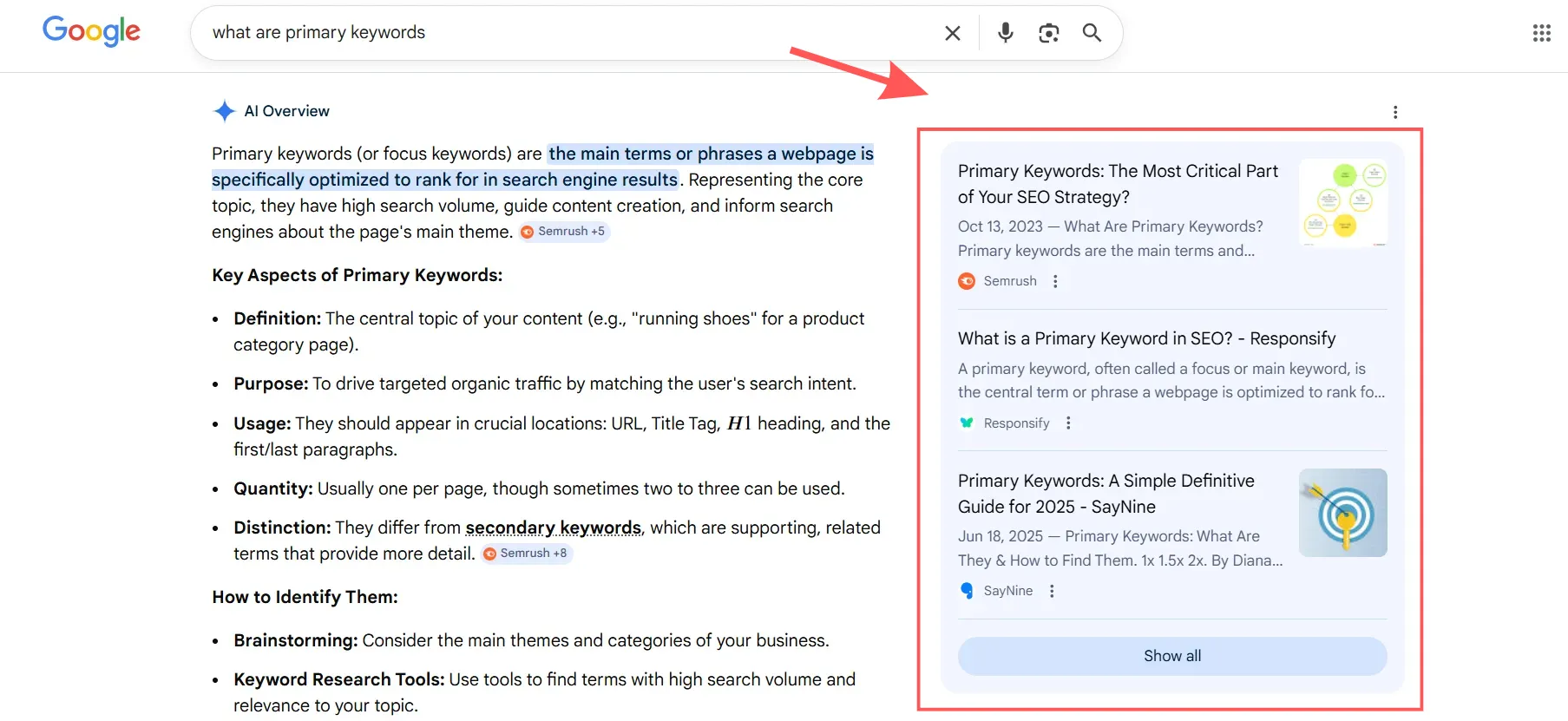
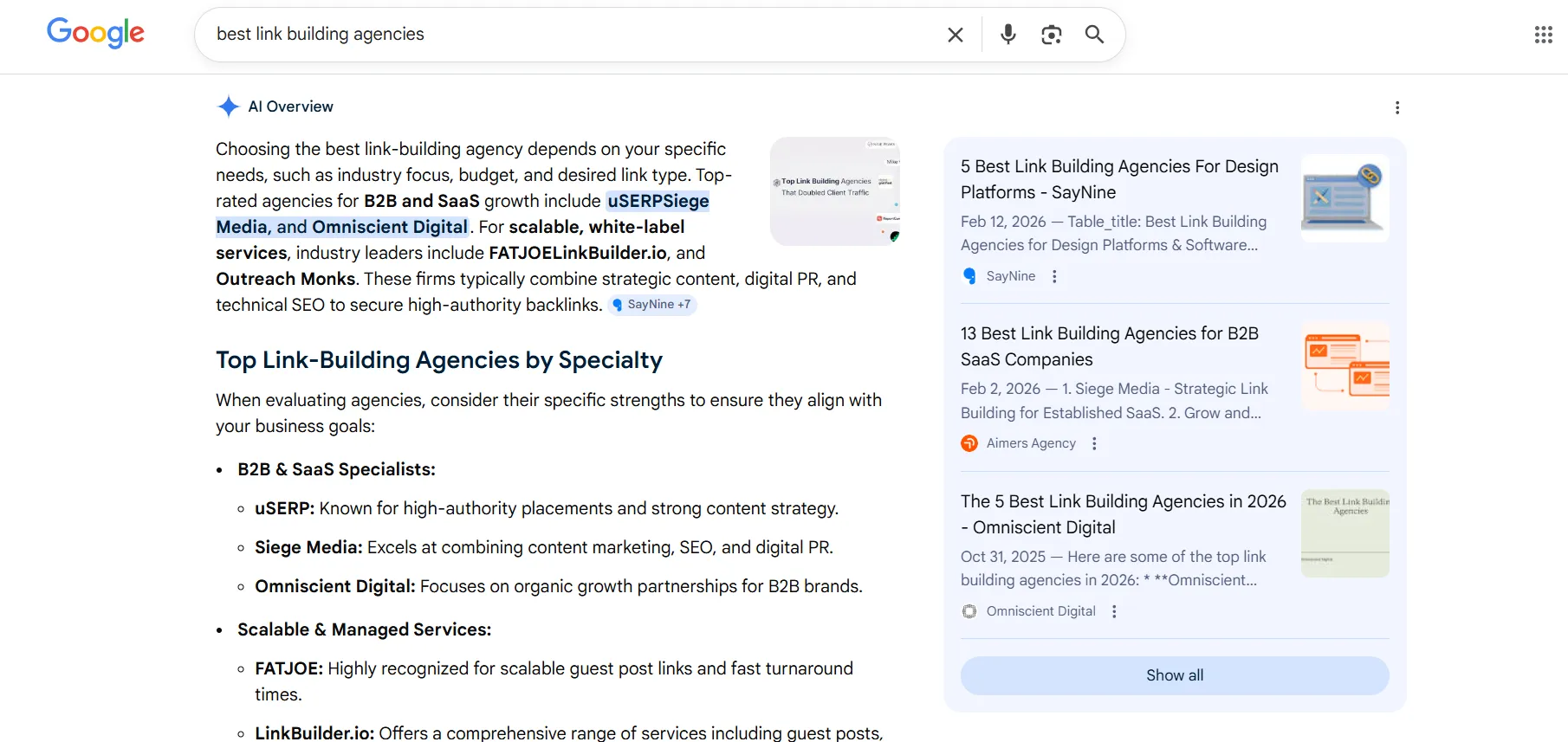
Here’s an example of a search query that generated an AI Overview.
And, what does it mean to rank in AI overviews?
These AI summaries often include cited links, which you can find on the right-hand side. It highlights all the sources the AI used. In this case, SayNine takes the third position.
The higher spot you take, the more visibility your content gains.
What Types of Queries Trigger AI Overviews?
If you want to know how to rank in AI overviews, you’ll need to understand what kind of keywords trigger them.
This information will help you optimize your content and increase your chances of appearing in AI-generated answers.
Here are the main types of keywords that trigger AI summaries.
- Informational Queries: Questions like “What is X?” or “How does Y work?” require clear, concise explanations. AI Overviews prefer content that directly answers these questions with structured, authoritative information.
- Comparison Queries: Queries like “X vs Y” or “Best alternatives to Z” often generate AI summaries because users want a clear, detailed answer in one place.
- List or “Best Of” Queries: Searches like “Top 10 tools for…” or “Best services for…” also trigger AI overviews because it’s easy for AI systems to extract, summarize, and compare structured information from list-style content.
- Problem-Solving Queries: Searches in the form of questions starting with “How to fix…,” “How to solve…,” or “Ways to…” work well because AI Overviews aim to provide actionable solutions.
- Multi-Source Knowledge Queries: Complex topics that require synthesizing information from multiple sites, such as “AI marketing trends 2026” or “Link building strategies,” are also more likely to trigger AI-generated summaries.
So, when creating content, make sure it covers some of these keyword types without compromising quality and depth.
AI Overviews vs Featured Snippets
Many people confuse these two features, as they both appear at the top of the search results and provide quick answers, but they work very differently:
Featured Snippets
- Show a direct excerpt from one website
- Usually pull information from a high-ranking page
- Rely on structured data such as schema markup
- Display the exact wording from the source
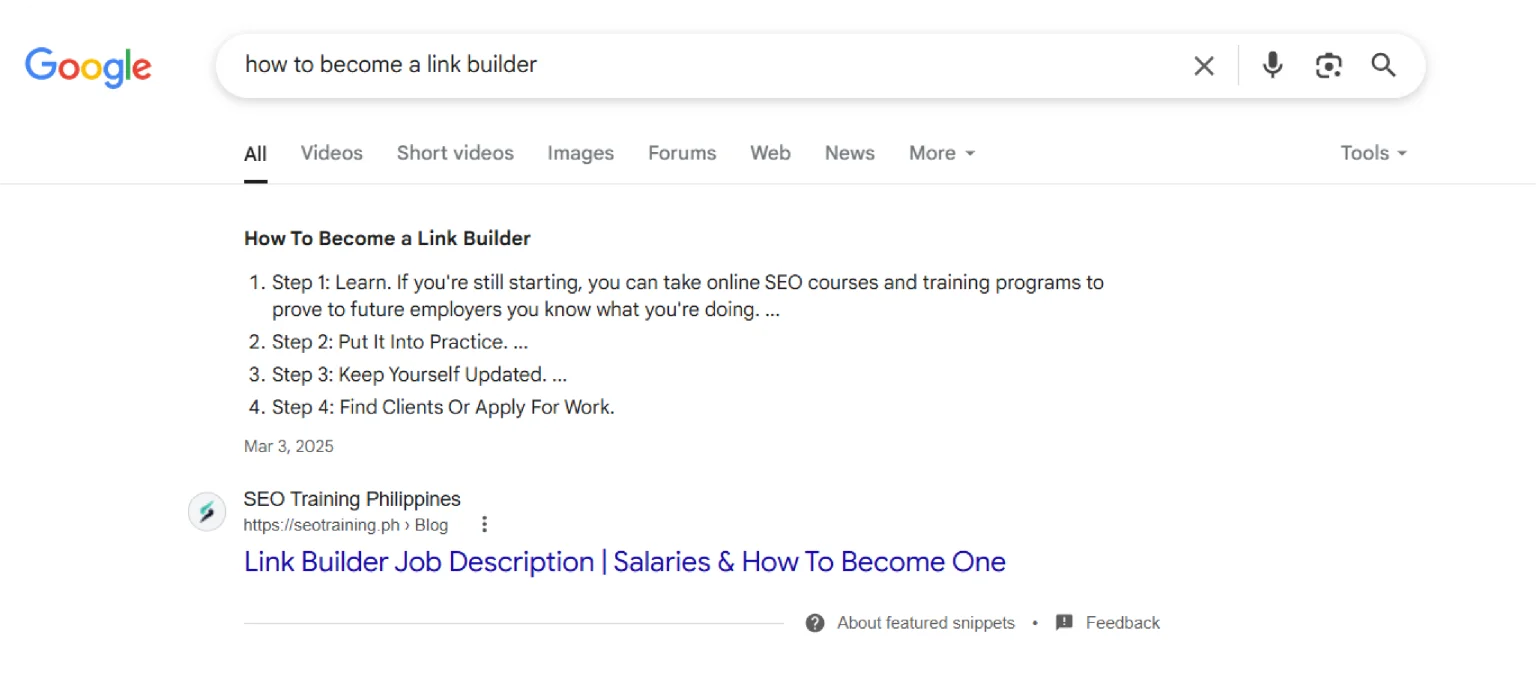
Here’s an example.
AI Overviews
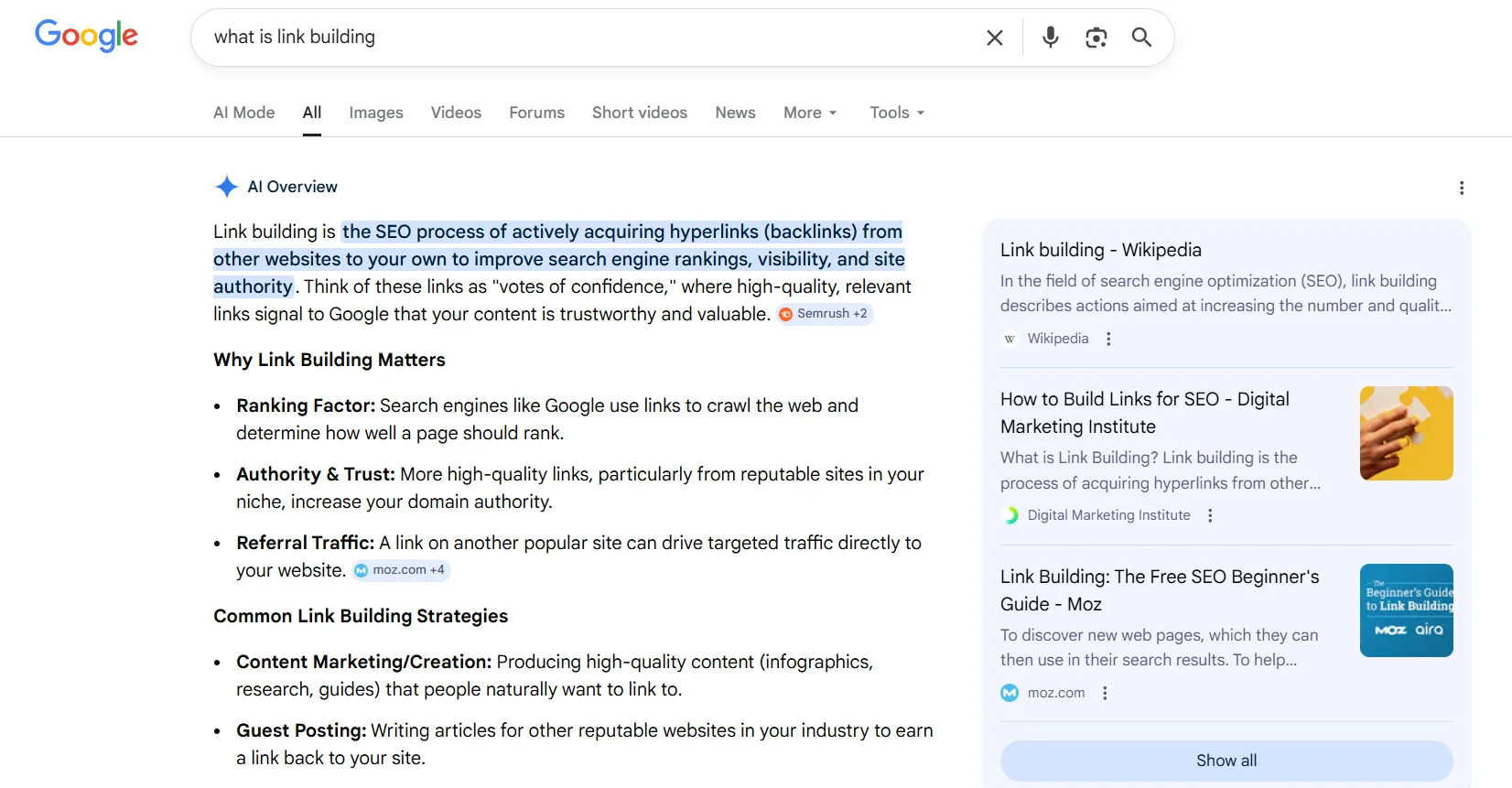
- Generate a summarized answer using AI
- Collect information from multiple websites
- Do not depend only on ranking position
- Provide a broader, AI-generated overview of the topic

Why is It Important to Show Up in AI Overviews?
Ranking in AI overviews puts your brand in front of more people and helps your content stand out, with benefits like:
- More brand visibility: AI tools cite only credible sources, so appearing in AI Overviews boosts your brand’s exposure and helps more people recognize and remember your brand.
- Increased authority: The more often your brand appears in AI Overviews, the more people will associate it with credibility and turn to it as a go-to resource in your industry.
- Competitive advantage: Showing up in AI Overviews helps your brand stand out, so users see you first. If two companies offer link building services, the one appearing in the AI summary gets noticed first.
- Improved traffic: AI summaries can drive users to click through for more details, increasing visits to your website.
How to Rank in AI Overviews: 3 Proven Tips
Get Featured in Listicles
One effective way to show up and rank in Google’s AI-powered search is to get included in list-format articles.
AI tools like AI Overviews frequently cite listicles for queries about “best,” “top,” or “alternatives to “services/products, tools, or companies” (e.g., “Best link building agencies”).
What makes listicles a favorite content format for AI systems?.
- They’re easy for AI overviews to scan, extract insights from, and summarize.
- They give immediate, comprehensive answers to user queries
- They break complex information into small, digestible parts
- They provide comparison tables, features, pros/cons, pricing, and use cases in one place
- They work perfectly for any industry. After publishing a structured listicle targeting ‘Best IT asset management tools,’ we saw a 60% increase in AI citations (AI overviews included) within 30 days. Read the full case study to see what worked.
Here’s what we advise when it comes to writing listicles.
Try different listicle formats
Below are some variations you can try:
- Commercial intent: “best,” “top,” “review”
- Alternative intent: “X alternatives”
- Comparison intent: “X vs Y”
- Problem-based intent: “tools for [pain point]”
Use a clear structure
AI systems extract structured “chunks.” If each listicle item follows the same layout, it becomes easier to parse.
For example:
Tool name
- Best for:
- Key Features:
- Pros:
- Cons:
- Pricing:
- Ideal Use Case:
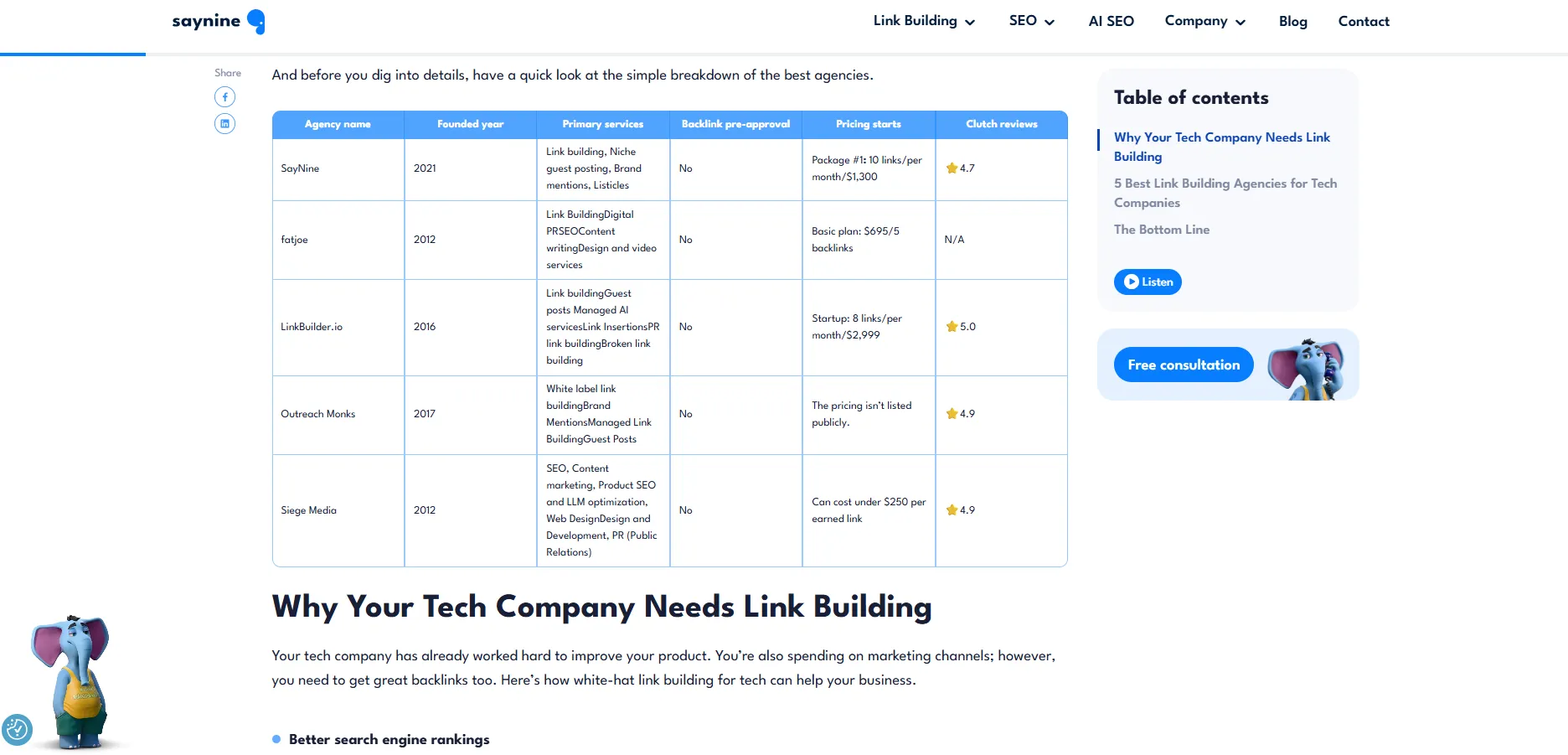
Add a comparison table
AI systems prefer structured data, and adding a table that summarizes key points helps them quickly scan and take the most important information from your listicle.
Grow Authority With Brand Mentions
Another important ranking factor for AI Overviews is the credibility and authority of your brand.
The more your brand is mentioned (both linked and unlinked) on trustworthy sources, the more likely you are to appear in AI-generated answers, which is one of the key benefits of brand mentions, as they naturally build credibility and strengthen your overall online presence.
Ahrefs’ study also proved that brands with more mentions get up to 10X more visibility in AI Overviews than the next closest quartile.
If you want to increase your brand’s AI Overview presence, here’s what to pay attention to:
- Build brand mentions only on relevant, industry-related websites.
- Track unlinked mentions and reach out to site owners to turn them into linked references.
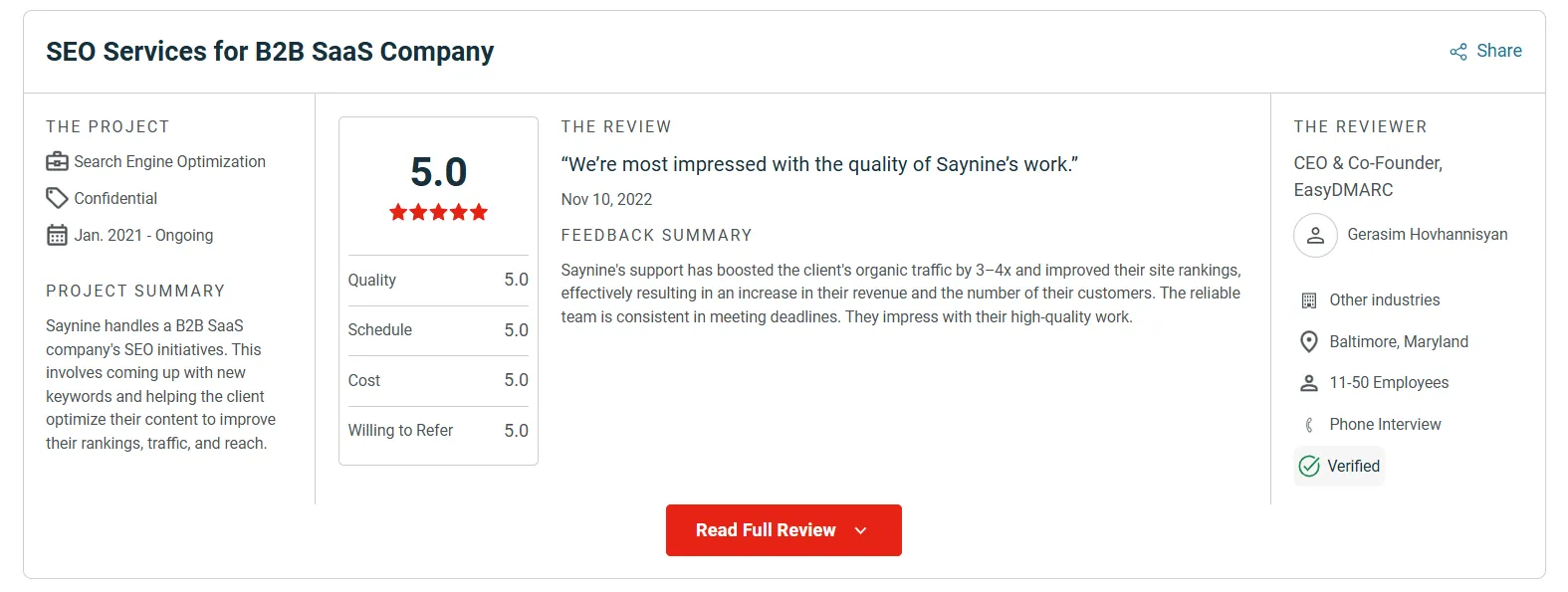
- Ask satisfied and happy clients to leave a review on platforms like Clutch. Third-party ratings build trust and help your brand get noticed.
Build a Strong SEO Foundation
AI is reshaping SEO, but it can never replace the need for discoverability, which is why many businesses are turning to AI SEO agencies to blend human strategy with advanced automation for better results.
No AI SEO strategy is complete without strong SEO fundamentals.
Generative AI engines like AI Overviews pull data from existing web content. If your site is not optimized, it won’t be referenced or linked as a source.
So, here’s what to prioritize and improve:
- On-page SEO: AI models heavily rely on quality and authoritative content. Focus on creating unique, original content that meets Google’s E-E-A-T guidelines. It should also have an easy and clear structure, so AI systems can understand and extract information.
- Link building: Non-shitty backlinks signal trust and authority. If your content earns links from other reputable sources, you get “votes of confidence” and become a reliable source of information. As a result, a strong backlink profile increases your chances of appearing in AI-generated answers.
- Technical SEO: If your website is too slow to load, is not crawlable, and has other technical issues, AI models may skip your website. Here’s a technical SEO checklist to help you get started.
If you already cover this part, then you are one step closer to ranking in AI overviews.
Wrapping Up
So, how to rank in AI overviews? Be a source worth citing.
Focus on structured content, build your brand’s authority, and keep your SEO fundamentals in shape. Do that consistently, and you will start frequently showing up in AI overviews.
Want help getting there? Check out our AI SEO services, and let’s make your brand the one that gets cited and recommended.
FAQ about how to rank in AI overviews
How to optimize content for AI search?
Focus on structured, unique content that answers user questions. Use clear formatting, informational, and comparison queries to appear in AI search results.
What is AI search optimization called?
It’s commonly referred to as AI SEO or generative engine optimization (GEO). It focuses on making your content easy for AI systems to find, understand, and cite.
How to track AI overviews?
You can use tools like SEMrush, Ahrefs, or AI visibility tools to track AI overviews and learn how often your brand gets cited.